
Iwate Prefectural University Launches a Research Project on Remote Driving Regulations — FUTU-RE Provides Technical Support
FUTU-RE has been commissioned by Iwate Prefectural University to develop the communication and control software that allows an autonomous vehicle to be driven remotely from a driving simulator (DS). Through this work, FUTU-RE is providing technical support to the research project “Fundamental Study for Establishing Remote Driving Regulations,” led by Associate Professors Shigeyuki Yamabe, Yoshikazu Arai and Shintaro Imai of the university’s Faculty of Software and Information Science.
01Background and Objectives
While research and development of autonomous driving is advancing around the world, full-scale deployment on public roads is still expected to take time. Vehicles must cope with complex environments shared with pedestrians and cyclists, keep many sensors running with high reliability, and the question of liability in the event of an accident remains open.
This is why “remote driving” is drawing attention: a driver in a distant location operates the vehicle while making use of autonomous driving technology. Because the driver remains responsible, just as in conventional driving, existing legal and insurance frameworks can be applied more easily, and remote driving is expected to reach society as a step toward full autonomy. Until now, however, remote driving research has focused mainly on communication reliability, and rules (regulations) for the remote driver have yet to be defined.
Rules for the remote driver have yet to be defined — this project aims to propose them first.
The project’s ultimate goal is to be among the first to propose regulations for remote driving. As a foundation, the team is building an experimental environment this fiscal year in which a real autonomous vehicle can be driven remotely from the laboratory’s DS. Looking further ahead, the team also plans to study new ways of driving in which a single driver operates multiple vehicles.
02System Overview
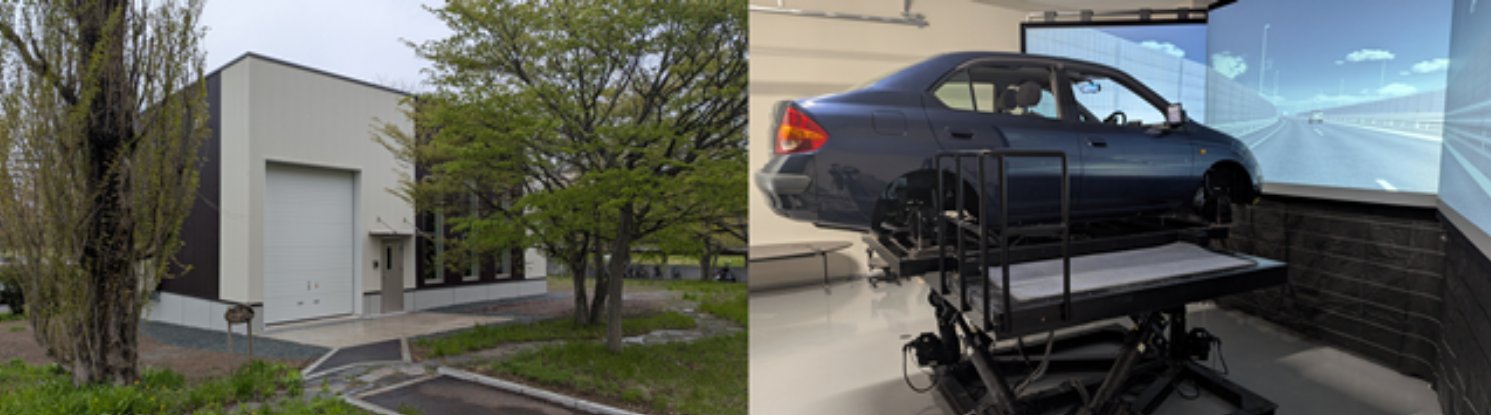
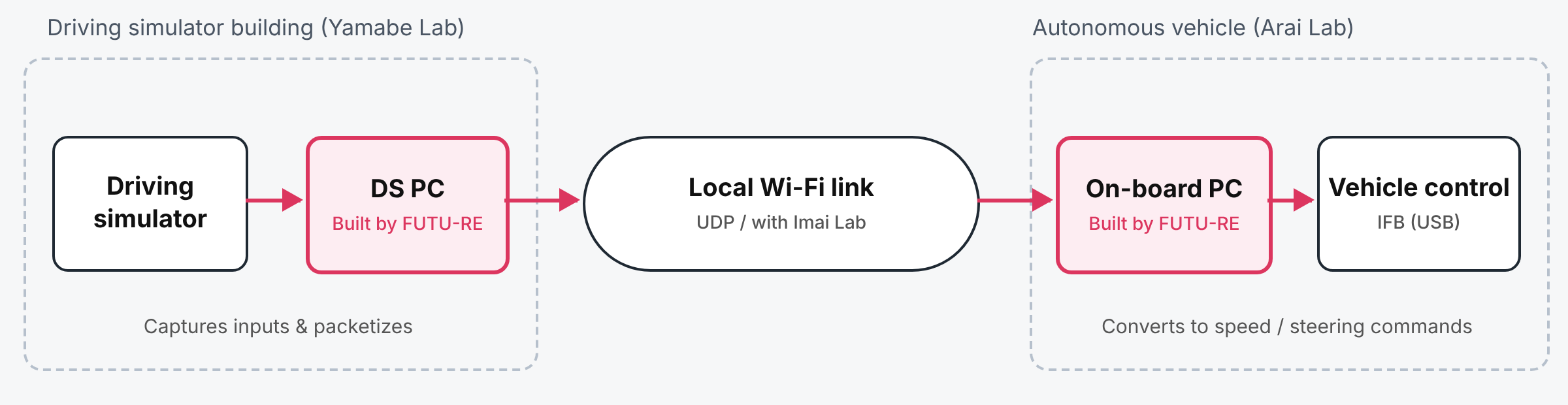
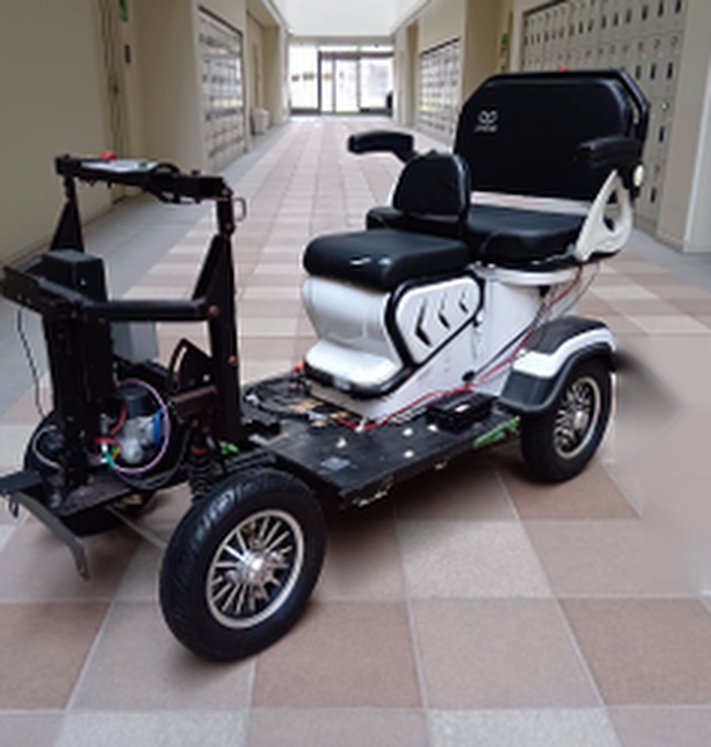
The driver’s steering, accelerator, brake, shift and turn-signal inputs on the DS are captured in real time and sent over local Wi-Fi to the autonomous vehicle outdoors. On the vehicle side, they are converted into speed and steering-angle commands so that the vehicle can “go, turn and stop” remotely. For safety, brake inputs must be delivered reliably and with top priority, and the communication method is being designed with this in mind. Working toward verifying operation on the actual vehicle within this fiscal year, the team conducted a driving test on the university campus on November 16.
03Research Team
Assoc. Prof. Shigeyuki Yamabe
Faculty of Software and Information Science, Iwate Prefectural University
- Role
- Project leader. Regulations for remote drivers; DS-side experimental environment.
- Expertise
- Driving-behavior and traffic engineering research using driving simulators (wrong-way driving countermeasures, Intelligent Transport Systems (ITS), etc.). Also participates in the “RoAD to the L4” project, which succeeded themes from the Cabinet Office’s SIP program.
Assoc. Prof. Yoshikazu Arai
Faculty of Software and Information Science, Iwate Prefectural University
- Role
- Control of the vehicle adapted from autonomous driving technology.
- Expertise
- Robotics, intelligent mechanical systems and mechatronics; research on teleoperation systems, semi-autonomous robots and outdoor work robots.
Assoc. Prof. Shintaro Imai
Faculty of Software and Information Science, Iwate Prefectural University
- Role
- Highly reliable, uninterrupted communication.
- Expertise
- Information networks, sensor networks and IoT; research on ad hoc networks, backup networks for disasters and drone-based communication.
FUTU-RE Co., Ltd.
Technical support (contract development)
- Role
- Communication and control software for the DS side and the vehicle side.
- Expertise
- Development and modification of autonomous vehicles, in-vehicle software and communication systems.
04FUTU-RE’s Technical Support
- 1DS-side softwareRetrieves steering angle, accelerator, brake, shift and turn-signal inputs from the DS data communication library, converts them into a proprietary packet format and transmits them over Wi-Fi.
- 2Vehicle-side softwarePerforms safety processing by checking whether each received packet is up to date, calculates speed and steering-angle commands, and feeds them to the vehicle’s interface board. FUTU-RE also developed a screen that displays the status of remote driving.
- 3Video from the vehicleA system for sending video from an on-board webcam to the DS side is also under consideration.
05Looking Ahead
The research will next expand from local Wi-Fi to remote driving over internet connections such as 5G, and to methods that allow one person to drive several vehicles. Through remote driving technology, the team aims to help solve social challenges such as labor shortages — including the shortage of bus and taxi drivers — and to secure mobility in areas where getting around without a car is difficult, as well as in snowy, cold regions. Drawing on the expertise it has built through developing autonomous vehicles, FUTU-RE will continue to support Iwate Prefectural University’s research on the technical side.

 English
 Japanese